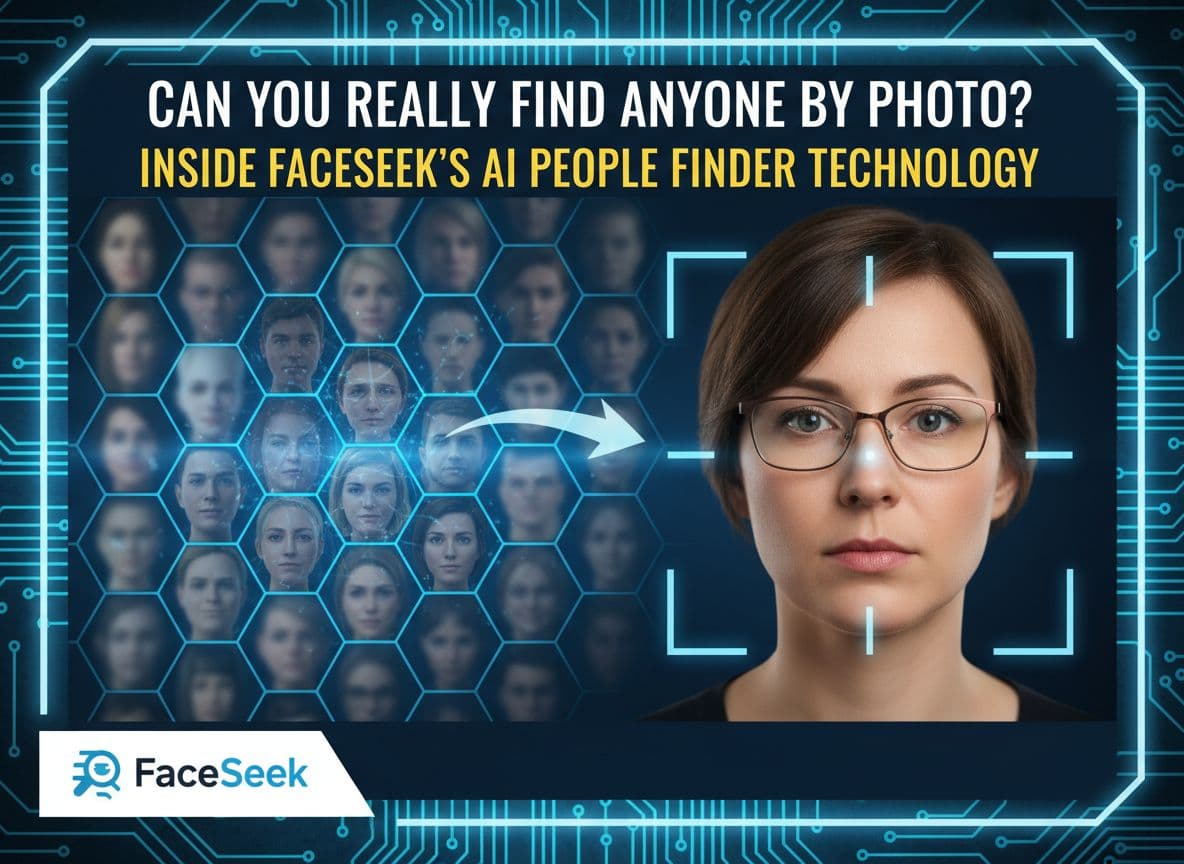
Can You Really Find Anyone by Photo? Inside FaceSeek’s AI People Finder Technology
Picture this: you have a single photo of someone and want to know who they are or where else that image appears online. The idea that you could find a person by photo with an AI people finder sounds a little like science fiction, yet tools like FaceSeek now make it a real option for many users.
FaceSeek is an AI face search tool that scans public photos across the open web. It uses an advanced image recognition tool to turn a simple face photo into a special numeric pattern, then compares that pattern to many other images. FaceSeek is a people finder for faces, not names, and it focuses on public content that is already available online.
In this article, the focus is on two questions. First, how does this type of AI face search actually work, in clear and simple terms. Second, what are the limits, risks, and smart ways to use a face search tool so you stay safe, fair, and grounded in reality.
If you want stronger background on the platform as you read, you can also review this guide that helps learn what FaceSeek is and its workings.
How FaceSeek Turns One Photo Into a People Finder Search
AI people finder tools can sound complex, but the basic idea is straightforward. You give FaceSeek a clear photo of a face. The system turns that face into numbers, then searches for similar number patterns in other images across the web.
You can think of it like a text search engine. When you type words into a search box, the engine does not match each pixel of text. It uses indexes, patterns, and scores to see which pages match your words. FaceSeek does something similar, but for faces instead of text.
FaceSeek does not scan the entire internet in real time each time you run a search. It works with images that have already been indexed from public sources. The AI then compares the “faceprint” from your uploaded image against those stored patterns and sorts the results by how similar they look.
The process has three main parts: turning the face into a digital faceprint, scanning for similar faceprints, and ranking the likely matches.
From Face Photo To Digital Faceprint: What Happens First
When you upload a photo into FaceSeek, the system does not simply look for someone with the same eye color or hairstyle. It uses AI models that focus on the structure of the face.
An image recognition tool first detects that there is a face in the picture. It looks at many tiny points on the face, such as the corners of the eyes, the curve of the jaw, and the distance between the nose and mouth. It measures how those points relate to each other.
These measurements form what experts call an embedding or a faceprint. You can think of this as a long list of numbers that describe how that face is shaped. Two photos of the same person will produce similar lists of numbers, even if the lighting, background, or camera are different.
This is a key idea. FaceSeek’s AI face search compares faceprints, not raw photos. The system does not need an exact copy of the photo. It needs enough detail to form a reliable faceprint, then it can look for similar prints in its index.
If you want a more detailed technical overview of how facial recognition converts faces into patterns, the article on how facial recognition technology works gives a helpful explanation from an industry view.
How AI Face Search Scans The Web For Matches
Once FaceSeek has the faceprint, it checks that numeric pattern against a large collection of faceprints built from public images on the web. This collection may include public social profiles, news sites, blogs, and other pages that search engines can reach.
You can compare this to a text search engine that matches keywords across indexed pages. Here, the “keyword” is the faceprint. The system measures how close each stored faceprint is to your query faceprint. It then ranks the results from strongest match to weakest.
FaceSeek is an AI people finder, not a magic tool. It can return strong matches, weak hints, and sometimes no meaningful match at all. Results depend on many factors, such as image quality, angle, and how often the person appears online.
The system may also produce false matches. Two people with similar facial structure can confuse the model, especially if the source photo is small, blurry, or taken at a sharp angle. The technology is powerful, but not perfect, which is why reading results with care matters so much.
Why FaceSeek Focuses On Public Data And Open Sources
FaceSeek is designed to work with images that are already public. It does not break into private photo albums, locked accounts, or closed messaging apps. Instead, it indexes photos that a normal search engine could reach.
The system focuses on open websites, public profiles, and other sources where people have shared images in public spaces. The difference is the kind of search. Traditional search tools focus on text keywords. FaceSeek focuses on faces.
This choice ties directly to privacy and ethics. By staying within public data, FaceSeek operates as an AI people finder for images that users have already shared with the world. It does not aim to expose private spaces. Later in this article, the privacy section will look more closely at how people should use this power in a responsible way.
Can You Really Find Anyone By Photo? What FaceSeek Can And Cannot Do
The honest answer is subtle. You can often find a person by photo if that person appears in public web images. You cannot find every person, and you will not get a match every time.
FaceSeek works well as a face search tool when there is enough public data to match. It struggles when there is little or no public footprint. Thinking about the tool in terms of realistic and unrealistic expectations helps keep things clear.
When FaceSeek’s People Finder Works Best (Realistic Use Cases)
FaceSeek’s people finder works best when the target person appears in several public photos online. That might mean they have social media accounts, public profile photos, or have appeared in public events covered by media.
Some realistic examples include:
Reconnecting with contacts: You might have an old class photo or an image from a conference. By running an AI face search, you might find profiles that show the same face, helping you reconnect.
Spotting scam or fake accounts: Scammers often reuse the same images across many fake profiles. FaceSeek can help spot this behavior by showing where a photo appears across different sites. Services for reverse image search for people, such as FaceSeek’s own advanced reverse image search by FaceSeek, are useful for this.
Checking dating profile photos: Many users want to know if a dating profile photo appears on other sites, such as stock photo pages or unrelated profiles. A face search can add context before you decide to trust someone.
Monitoring your own presence: You may want to see where your own selfies or professional headshots appear. FaceSeek makes it easier to track how your face spreads across platforms.
In each of these cases, you use an image recognition tool not to spy, but to verify information and protect yourself. The people finder element helps connect faces to public profiles or pages, but results should always be seen as starting points, not final proof.
For more background on how face recognition fits into broader computer vision, Microsoft’s overview of what face recognition is in AI gives helpful context.
Why You Cannot Always Find Anyone, Anywhere, With One Photo
Popular stories can give the false idea that AI can find anyone, anywhere, from a single snapshot. Reality is different. FaceSeek and similar tools have clear limits.
You will likely get weak or no results when:
The person avoids social media or rarely posts photos.
Their accounts are private or behind login walls.
The only photo you have is very small, dark, or blurry.
The image shows a side angle, heavy filters, or sunglasses.
The person has changed appearance a lot, for example after surgery or many years apart.
The subject is a child, whose online presence may be limited or protected.
FaceSeek does not connect to government databases, airports, or law enforcement cameras. It also does not search private cloud storage or closed corporate systems. It works on open web data only.
No AI people finder can claim a 100 percent hit rate. Anyone who promises that is not being honest. Results should be treated as clues that help guide further research, not as a final verdict on someone’s identity.
For perspective on technical weaknesses, such as poor image quality and small image sizes, you can read this overview of limitations of facial recognition technology.
Accuracy, False Matches, And How To Read Results Safely
When FaceSeek finishes a search, it returns a list of possible matches with images and links. Some may look very similar, others less so. Accuracy depends on both the algorithm and the quality of your starting image.
Users should keep several basic rules in mind:
A high similarity score means “likely”, not “certain”.
People with similar facial features can trigger false matches.
Side views, makeup, filters, and low light can confuse the model.
Smart ways to read results include:
Compare multiple photos of the same match, not just a single image.
Check context on the linked pages. Read names, locations, and profile details to see if they align.
Look for repeated matches across different websites. When the same face appears in many places, confidence grows.
Avoid quick judgment. Do not make harsh claims about fraud or misconduct based only on one match.
These habits reduce the risk of misidentifying someone or drawing unfair conclusions. The same care is advised by independent groups that study privacy and bias. For example, research on privacy and ethics in face recognition discusses both the power and the risks of misclassification.
Privacy, Ethics, And Safe Use Of AI Face Search Tools Like FaceSeek
Any face search tool raises hard questions about privacy, consent, and possible abuse. The fact that a photo is public does not remove all ethical duties. Users must think about how they use information, not only how they obtain it.
FaceSeek’s design, with a focus on public data and open sources, tries to respect a reasonable balance. Still, the real impact depends on how people use the tool in daily life. A people finder can help someone reconnect, or it can help someone stalk. The technology is the same; the intent is not.
Groups that track data protection have raised concerns that facial data can lead to stalking, harassment, or identity theft if mishandled. A short overview on facial recognition and privacy concerns outlines several of these risks.
How FaceSeek Handles Public Photos, Consent, And Responsible Use
FaceSeek focuses on public images that a regular browser or search engine can reach. It respects site rules and legal limits about scraping and indexing. It does not crack passwords or bypass technical locks to get private content.
At the same time, using any AI people finder carries social responsibility. Some simple ethical rules help keep use on the right path:
Do not use search results to harass or threaten people.
Do not repost private or sensitive details from a profile found through FaceSeek.
Do not use the tool to support blackmail or extortion.
Respect platform rules when contacting someone whose photo you discovered.
The FaceSeek blog post on how it helps you track your face's online presence with FaceSeek offers a broader view of how the tool is intended for protection and monitoring, not for surveillance of others.
Anyone who uses people finder apps should think about basic ethical practices. Guides such as this article on how to use people search tools safely and ethically suggest common sense rules, like asking for consent when reasonable and avoiding public sharing of sensitive data.
Good vs. Harmful Uses: How To Stay On The Right Side
The same AI that helps a creator protect their identity could also help a harasser track a victim. Drawing a clear line between healthy and harmful uses is key.
Examples of fair use:
Checking where your own face appears online to watch for impersonation.
Verifying if a profile photo on a marketplace or dating app is tied to clear scam patterns.
Finding public content from an old colleague when you have a shared past and a good reason to reconnect.
Examples of harmful use:
Using FaceSeek results to stalk or follow someone who does not want contact.
Collecting private details from profiles and posting them in hostile forums (doxxing).
Running repeat searches to track someone’s movements across platforms in an obsessive way.
A simple test can guide choices: ask whether you would feel comfortable if someone used the same people finder process on you in the same way. If the thought feels invasive or unsafe, that is a strong signal to stop.
How FaceSeek Compares To Other Face Search Tools Like Faceonlive
FaceSeek is part of a wider field of face search tool services. Other brands, such as Faceonlive, also offer face serach by image with a focus on public photos. For example, Faceonlive describes its own product as a way to free face search online and offers a simple upload and scan flow.
FaceSeek’s distinct focus is on people search by image, privacy, and identity protection. It aims to act as both a people finder and a shield for users who want to monitor their own likeness. The interface is built to be straightforward for non-specialists, so users can upload a photo, review matches, and act on the results with minimal friction.
While many platforms share the same core concept, FaceSeek places strong weight on public data, clarity about use cases, and tools that help people understand where their face appears online rather than just offering raw matches.
Getting Started With FaceSeek: Smart Tips For Your First AI People Finder Search
Turning a face photo into a people search is simple once you understand a few basics. With the right image and a clear purpose, FaceSeek can provide helpful context about where a face appears online.
A basic search follows a short process:
Decide why you want to run the search, for example to check your own images or to validate a profile photo.
Choose the best available source image.
Upload the image into FaceSeek’s interface.
Review the results with care, using the tips in this section.
For a walkthrough of the upload flow and how FaceSeek’s AI reverse image search engine works, the advanced reverse image search by FaceSeek page gives step-by-step guidance.
Choosing The Right Photo For The Best Face Search Results
The photo you choose has a large impact on the quality of your results. Because the AI needs to read fine details of facial structure, clarity matters more than style.
Good practices for a strong source image:
Use a front-facing photo with the full face visible.
Avoid heavy filters, masks, and large sunglasses.
Pick an image with good, even lighting.
Make sure the face is not too small in the frame.
If there are many faces in one photo, crop it so that only the target face remains.
Group photos, tiny profile icons, or pictures taken from far away give weak faceprints. The AI face search system may struggle to extract reliable measurements between key facial points, which reduces the chance of strong matches.
In short, treat the source photo like a passport or ID picture. Clear, simple, and focused beats artistic or heavily edited images when it comes to face serach.
Reading FaceSeek Results And Taking Care With What You Do Next
After running a search, you will see a list of possible matches, each with a thumbnail and a link to the page where that image appears. The goal is to scan these results with a calm, careful eye.
Helpful habits include:
Look across the top matches, not just the first one.
Check if the same face appears on multiple sites with similar details such as name or location.
Ignore matches that clearly show someone with different age, features, or context.
Once you believe you have found a relevant match, think carefully before acting. If you plan to reach out to the person, follow the rules of the platform where you found them. Do not spam, and do not pressure them for information.
If the search reveals sensitive posts, avoid sharing them publicly unless you have consent or a strong public interest reason. Respect and restraint make the difference between fair use of an AI people finder and misuse.
For Creators And Brands: Use FaceSeek To Protect Your Image And Reputation
Content creators, influencers, and brands often have strong reasons to monitor where their faces and logos appear. For them, FaceSeek acts as a reverse people finder. Instead of searching for others, they search for themselves.
Examples of how creators and brands can use faceseek:
Spot fake accounts using the same profile photos to scam followers.
Find pages that copy branded images without permission.
Track how images spread across meme pages, fan accounts, or low quality clone sites.
By running routine AI face search checks, a creator can catch misuse early and request takedowns where needed. In fields where identity and visual trust matter, this helps protect reputation and public confidence.
FaceSeek’s role as an image recognition tool is not limited to finding strangers. It can be a regular part of a brand’s online protection toolkit, alongside keyword alerts and traditional search monitoring.
Conclusion: AI People Finder Power, Limits, And Next Steps With FaceSeek
You can often find a person by photo today, but only within clear limits. Tools like FaceSeek show how far AI face search has progressed, yet also highlight gaps. The system works best with clear, front-facing images and people who appear in many public web photos. It struggles when images are poor, accounts are private, or the person has little online presence.
FaceSeek’s strength lies in its focus on public data and its role as a people finder that adds context rather than secret files. Results are clues, not courtroom evidence. Users who treat matches carefully, compare multiple sources, and act with respect can use the tool in a safe, fair way.
As facial recognition and face serach tools become more precise, questions about privacy, consent, and ethics will matter even more. Individuals, creators, and brands will need both technical awareness and clear personal rules for how they search and how they respond to what they find.
If you are a creator, influencer, or business that wants more reach and protection, you can get your brand featured on FaceSeek through the partner program. Used with care, AI tools like FaceSeek can help you watch over your identity, connect with real people behind public photos, and keep your online presence aligned with who you really are.